How Does Self-Fusing Tape Eliminate Air Voids in High-Voltage Insulation?
The Critical Weakness in Traditional Cable Repair
In high-voltage power and telecommunications networks, cable joints and terminations are the most vulnerable points of failure. The primary culprit is often not the insulation material itself, but the presence of microscopic air voids trapped between layers of tape or at interfaces. These voids create localized electric field concentrations, leading to partial discharge (corona)—a silent killer that gradually erodes insulation, accelerates aging, and ultimately causes catastrophic breakdowns, especially under demanding environmental conditions.
Conventional PVC or rubber tapes, which rely on adhesive backing, are prone to gaps, wrinkles, and inconsistent tension during manual application. This inherent inconsistency makes it nearly impossible to achieve a perfect, void-free seal. The solution to this engineering challenge lies not in thicker materials, but in a fundamentally different application mechanism: self-fusion.
The Physics of Self-Fusing: Creating a Monolithic Barrier
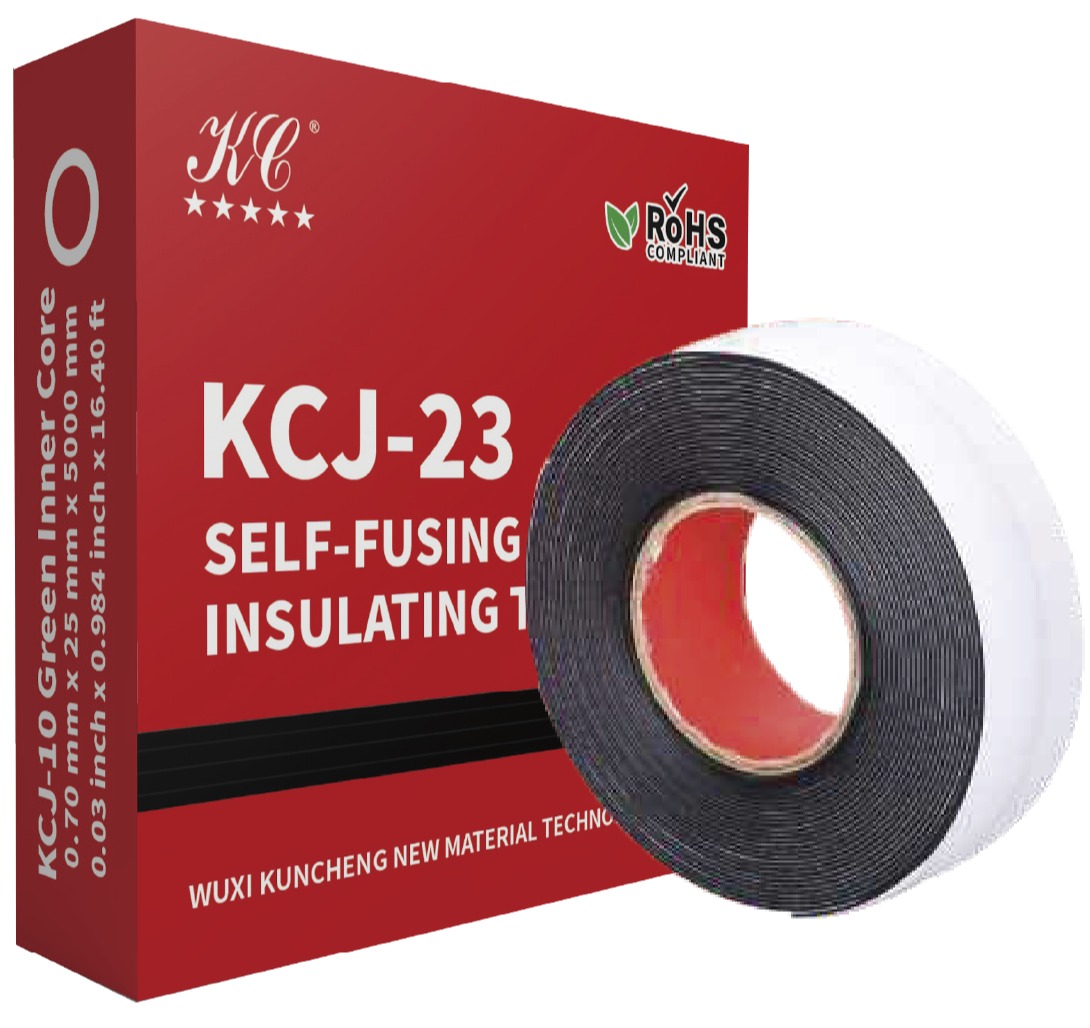
Self-Fusing Insulating Tape (often based on IIR or EPR compounds) operates on a principle radically different from adhesive tapes. It contains no sticky adhesive layer that can fail over time. Instead, it relies on molecular inter-diffusion.
- The Stretch-Activated Mechanism: During installation, the tape is stretched (typically 200% or more). This mechanical stress breaks down the surface layer of the material, exposing fresh, uncured polymer chains.
- Void Elimination: When the stretched tape is wrapped under tension with a 50% half-lap, the exposed polymer chains from one layer intermingle and cross-link with the layer beneath. Over a short period (aided by ambient temperature and pressure), these layers amalgamate into a single, homogeneous, solid rubber mass.
- Perfect Conformity: Unlike pre-molded rigid sleeves, the self-fusing process allows the material to flow into every microscopic irregularity on the cable surface, perfectly contouring to the substrate and literally squeezing out any potential air pockets. The result is a seamless, void-free insulation system that replicates the dielectric integrity of a factory-molded cable.
Key Performance Advantages Beyond Basic Insulation
The ability to eliminate air voids is the primary benefit, but the technology delivers several critical operational advantages for field engineers.
- Superior Dielectric Strength: By removing air gaps, the system maintains a uniform electric field, significantly increasing the dielectric strength (up to 35 kV/mm for high-grade tapes) and allowing for reliable operation at voltages up to 110 kV and beyond.
- Intrinsic Waterproofing: The monolithic seal created by self-fusion is inherently waterproof. It provides an excellent barrier against moisture ingress, which is a major cause of electrochemical degradation and insulation failure in underground or humid environments.
- Environmental Resilience: High-quality self-fusing tapes offer excellent resistance to ozone, UV radiation, and temperature extremes. This ensures long-term stability and prevents the cracking or brittleness that can plague inferior tapes exposed to the elements.
Application Scenarios: Where It Matters Most
This technology is particularly critical in situations where reliability is non-negotiable and factory-perfect conditions are unavailable.
- Underground Distribution Cable Splices: Restoring the insulation on faulted or aged cable joints in utility networks, where moisture and partial discharge are constant threats.
- Renewable Energy Interconnections: Protecting cable terminations in solar farms and wind turbines, where cables are exposed to wide temperature swings and mechanical stress.
- Rail Transit & Telecom: Ensuring moisture-proof and corrosion-resistant seals on power and communication cables in tunnels and along rail lines.
For engineers specifying repair materials, understanding the self-fusing mechanism is key to selecting a solution that goes beyond simple wrapping. It is the only field-applied method that scientifically addresses the root cause of insulation failure—air voids—by creating a true, solid-rubber dielectric barrier.